When a child’s imagination first rises off the page and stands up in three dimensions, spatial thinking, creativity, and early math skills open up in a whole new way.
Almost every child has gone through this stage: they draw a line on paper and ask, “What is it?” A 3D printing pen takes that line off the page. The filament is melted, extruded, and then cools into a real, standing line in three dimensions. What looks like a simple act of turning a drawing into something solid actually activates a whole set of cognitive abilities. This article draws on research in children’s cognitive development, spatial thinking, and creativity to explain why 3D printing pens—especially the low-temperature models designed for kids—are increasingly seen by parents as growth-oriented toys.
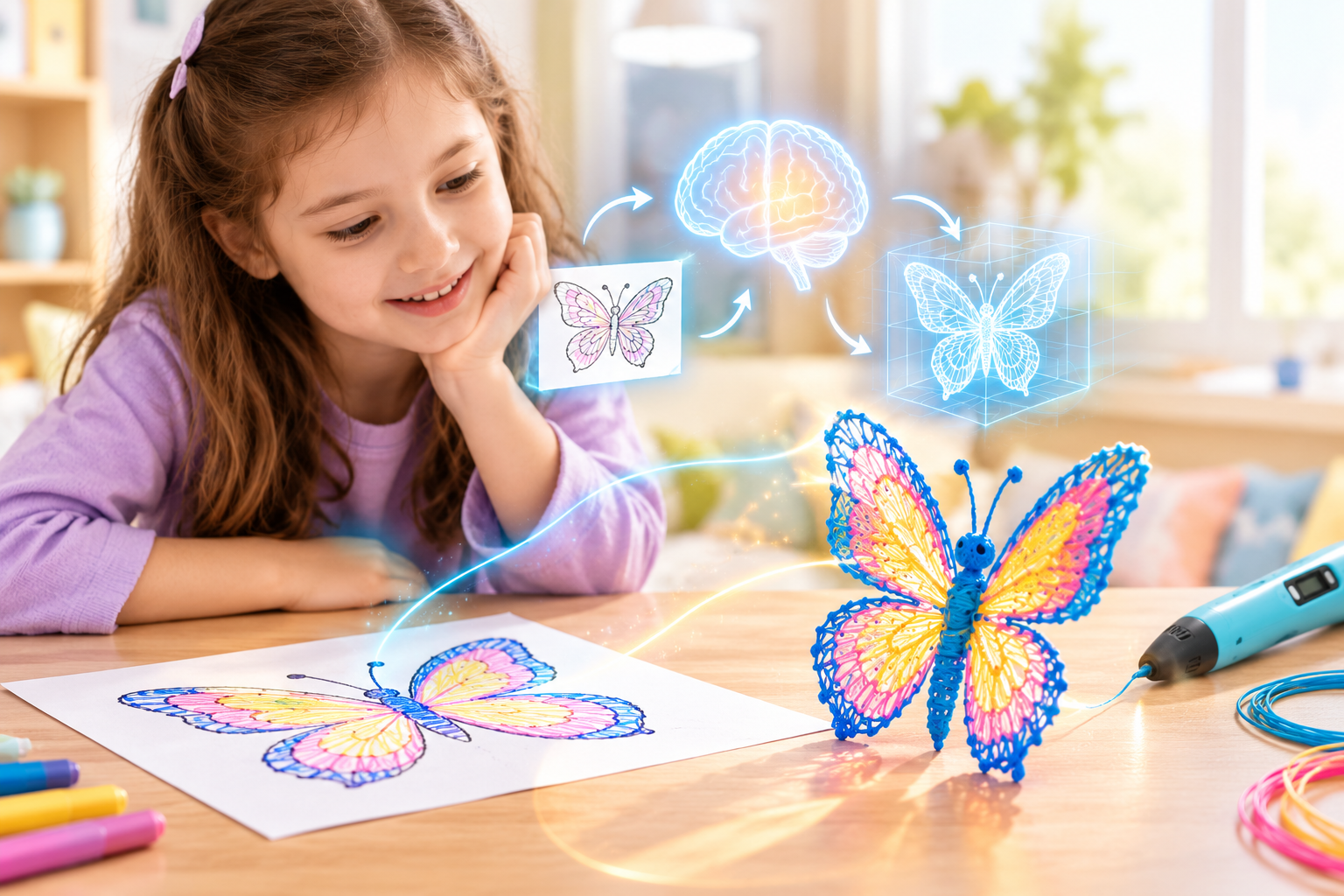
What makes a 3D printing pen special is that it forces a child to make a “dimensional leap”: turning an idea from a flat, two-dimensional surface into a real three-dimensional object with length, width, and height. This translation process itself becomes a training ground for several higher-level cognitive skills.
Imagination is not random daydreaming. It is a cognitive process of taking existing experiences and recombining them to create new possibilities. Vygotsky’s classic work already pointed out that children’s imagination and creativity are built on their prior experience—it is the ability to continually “reconstruct” reality through play [1]. Modern cognitive research further emphasizes that imagination is a cross-domain, transferable fundamental skill. It allows us to picture “how things could be” and, on that basis, make predictions, plans, and decisions. For this reason, imagination is considered just as important as learning and reasoning ability [2].
When a 5-year-old decides to make a “standing butterfly” with a 3D printing pen, the child is simultaneously planning shape, structure, support, and sequence in their mind. This is exactly the process of turning imagination from pure fantasy into an executable idea.
The “dimensional leap” of three-dimensional creation relies heavily on spatial thinking, especially mental rotation and scaling. A child must imagine in their mind how a shape will look after it is flipped, rotated, enlarged, or reduced. Research shows that these spatial abilities are trainable, and they are closely linked to children’s later mathematical performance. Spatial training given to 8-year-olds has been found to transfer to other untrained spatial skills and even to math scores [6]. This is the deeper educational value of moving from 2D to 3D: it turns spatial thinking from an abstract concept into a hands-on, practical activity.
Drawing a picture is immediate. Making something with a 3D printing pen, however, requires first forming an idea, then planning the steps, then carrying them out—and often making adjustments along the way. This complete cycle of “idea → plan → physical object → further adjustment” is the core of what constructivist education calls “learning by making”: children do not passively receive knowledge; they actively build understanding by creating objects with their own hands [3]. When a child sees their idea actually stand up in three dimensions, the sense of achievement fuels their willingness to try even more complex ideas.
If cognitive theory explains why they are useful, then evidence from classrooms and homes shows that they truly are suitable for children.
Research on the use of 3D printing pens in school mathematics has found that when students personally “make” geometric solids with a 3D printing pen, their understanding of three-dimensional shapes becomes significantly deeper. Researchers describe this as embodied learning by making: the learning process shifts from simply “watching” to actively “creating with their own hands” [4]. This means children do not learn geometry by memorizing definitions; they understand it by building it themselves.
Research on the use of 3D printing pens in basic education also shows that they can make abstract science and math concepts “visible and touchable.” This sparks children’s curiosity and engagement, making learning more concrete and rewarding [5]. For a child, the confidence that comes from “I can make this myself” often opens the door to continued exploration far more effectively than any lecture.
Many children have rich ideas in their minds but are limited by the tools available to express them. A 3D printing pen gives them a direct way to output their creativity: no complicated modeling software is needed. As long as they can imagine it and dare to draw it, they can turn what is in their mind into reality. This experience of having their ideas respected and realized is extremely important for building long-term self-confidence and a lasting desire to create.
“Children are not empty bottles waiting to be filled; they are actively building their own understanding with their hands.”
This is the fundamental reason why tools like the 3D printing pen are favored by educators.
How much do “moving from 2D to 3D” and “turning ideas into reality” actually benefit children? A large body of research on spatial training gives a clear positive answer—and the benefits are both transferable and measurable.
A meta-analysis covering 217 studies found that spatial skills training produces an overall effect size of approximately 0.47 standard deviations in the general population. When limited to children under 13, the effect size rises further to about 0.61, showing that spatial thinking is especially plastic during childhood [7]. In other words, spatial ability is not fixed at birth—it can be trained and improved.
Empirical research with 8-year-olds has confirmed that children who receive spatial training not only improve on the specific spatial skills that were trained (near transfer), but also show gains in untrained spatial skills (intermediate transfer) and even improvements across multiple areas of mathematics (far transfer). Based on these findings, researchers have proposed a causal influence of spatial ability on math performance [6]. The same conclusion is supported by studies of embodied spatial training: hands-on spatial practice can significantly improve children’s mathematics learning [8].
Taken together, the evidence points to a practical conclusion for parents: spatial training works largely because it exercises foundational cognitive components such as mental rotation, spatial scaling, and proportional reasoning [6][8]. A 3D printing pen provides frequent, intuitive, and repeatedly trial-and-error practice in three-dimensional transformation. Every stroke a child makes involves a mini mental rotation and spatial planning exercise. In this sense, the pen does not train spatial thinking only as a side effect—it naturally makes spatial thinking the core activity.
A 3D printing pen holds more than just a roll of filament—it holds a child’s mental leap from two dimensions into three. It lets imagination stand up, turns plans into action, and makes spatial thinking visible. The low-temperature design and the moments shared with parents remind us of something important: the best educational tools must not only benefit the brain, but also fit comfortably in a child’s hand. When a child first holds up a little dinosaur they “drew” into existence and cheers with excitement, you will understand—this journey from 2D to 3D is one worth taking seriously
Note: The superscript numbers [1]–[9] in the main text correspond to the references listed above. Content not directly cited consists of original interpretations based on the literature and is intended for science communication and educational reference.
This article is based on publicly available research in cognitive development and education. It is provided for informational and educational purposes only and does not constitute professional educational or medical advice. Always follow the product instructions and supervise children during use.